Historical Periods in the Development of Hindu Deities
Contents
- Overview
- Period 1: Indus Valley / Pre-Vedic (c. 2600–1900 BCE)
Proto-Shiva debated, Mother Goddess - Period 2: Proto-Indo-Iranian (2nd millennium BCE)
Mitra, Varuna, Indra, Nasatya/Ashvins — Mitanni treaty 1400 BCE proof - Period 3: Early Vedic / Rig Vedic (c. 1500–1000 BCE)
33 Gods, Trayastrimshata, no yoga, no temples - Period 4: Late Vedic / Upanishadic (c. 1000–500 BCE)
Brahmanas, Aranyakas, Principal Upanishads. First Brahman, Atman, Karma, Samsara. First word “yoga” — Katha Upanishad 5th–1st BCE - Period 5: Second Urbanization / Shramana (c. 600–200 BCE)
Buddhism, Jainism, Bhagavad Gita, early systematic yoga concepts - Period 6: Classical / Epic-Puranic (c. 200 BCE–500 CE)
Ramayana, Mahabharata finalized, Patanjali Yoga Sutras, Trimurti starts - Period 7: Early Medieval / Puranic Peak (c. 500–900 CE)
Devi Mahatmyam 5th–6th CE, Mahadevi supreme, Hirapur 64 Yogini Temple 864 CE — first stone Kali on Shiva as 2-armed - Period 8: Medieval Tantric (c. 900–1400 CE)
Ten Mahavidyas codified, Kalika Purana 10th–11th CE, first Hatha text Dattatreyayogashastra 13th CE - Period 9: Late Medieval / North Indian Bhakti & Hatha Codified (c. 1400–1700 CE)
Bhakti movement, Hatha Yoga Pradipika 15th CE with 15 asanas, Gheranda Samhita 17th CE - Period 10: Early Modern / Colonial & Modern Postural Yoga (c. 1700–1947 CE)
Brahmo Samaj 1828, Arya Samaj 1875, Surya Namaskar invented 1920s by King of Aundh, standing poses added by Krishnamacharya 1930s–50s - Period 11: Modern / Global (1947–present)
Iyengar Light on Yoga 1966 first modern usage of Ardha Chandrasana, global yoga - Summary Timeline
- Sources
Overview
The Hindu pantheon did not appear all at once. It developed through distinct, overlapping periods — each with its own evidence, forms of worship, and primary deities. These periods overlap: Vedic fire sacrifice continued for centuries after Puranic temple worship began, and Tantric practice coexisted with Bhakti devotion. Understanding this chronology is essential for placing the gods in their correct historical context, especially when examining their connection to yoga and asana practice.
Tech Note: Attempts to decipher the Indus Script
Period 1: Indus Valley / Pre-Vedic Religious Culture
Date: Mature Harappan phase, c. 2600–1900 BCE
Evidence
The Indus Valley Civilization (also called the Harappan Civilization) flourished across parts of modern-day Pakistan, northwest India, and northeast Afghanistan from approximately 3300 to 1300 BCE, with its mature urban phase dated to c. 2600–1900 BCE. The Indus script remains undeciphered, so our understanding of Harappan religion comes entirely from archaeological finds — seals, figurines, and ritual objects — rather than texts (Ref: Encyclopedia Britannica).
Key Finds
- Terracotta female figurines: Found in large quantities across Harappan sites, these are widely interpreted by scholars as icons of a fertility or mother-goddess cult. Similar figurine traditions are found across the Neolithic Near East and the Mediterranean from around 5000 BCE onward (Ref: Encyclopedia Britannica).
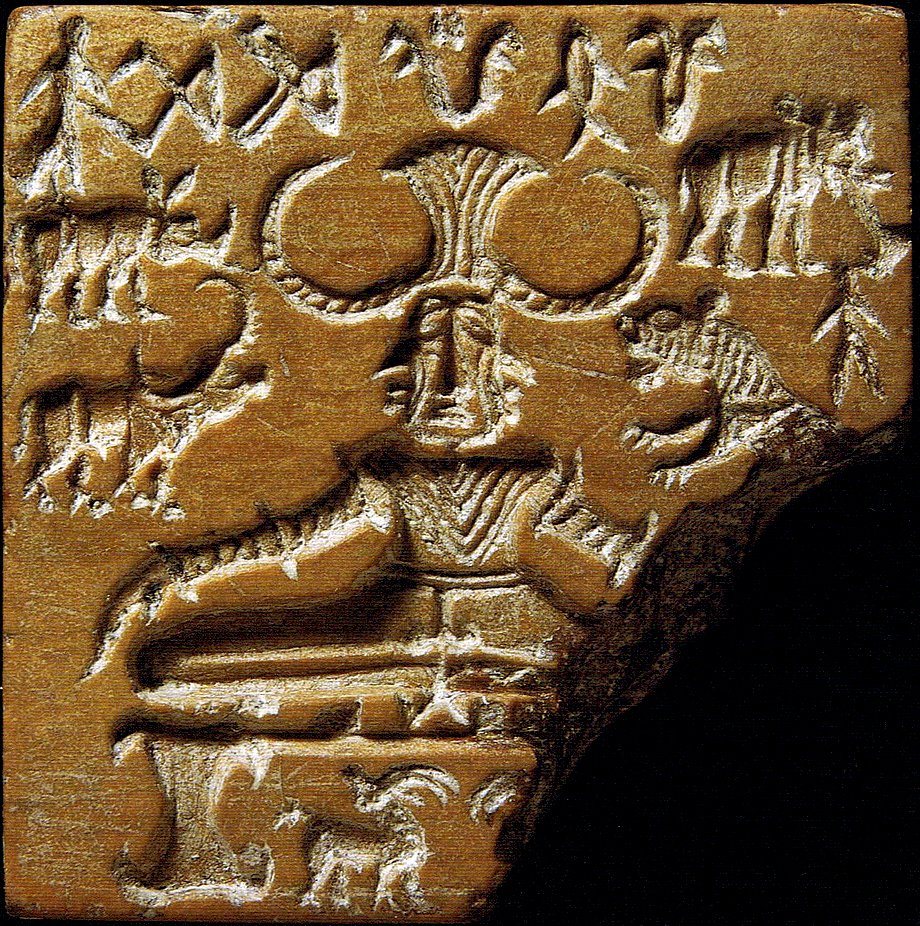
- The Pashupati Seal (Mohenjo-daro Seal No. 420): A steatite seal depicting a horned figure seated cross-legged in a meditative posture, surrounded by animals — an elephant and tiger on one side, a rhinoceros and buffalo on the other, with two deer beneath the throne. The seal was named “Pashupati” (Lord of Animals) by Sir John Marshall, who directed the Mohenjo-daro excavations and identified the figure as a “proto-Shiva” (Ref: Legacy IAS Academy).
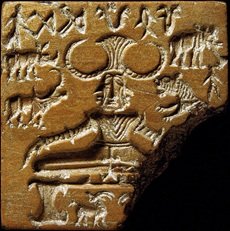
Click above thumbnail image for large size: Photograph of the "Pashupati" seal (M-304 A), Mohenjodaro, Indus Valley Civilization (c. 2600–1900 BCE). The original seal is in the collection of the National Museum, New Delhi. This image is in the public domain. - Phallic emblems and ring stones: Conical stone objects resembling later Shiva-lingas and ring stones resembling later yoni-rings have been found at Indus sites, suggesting possible fertility-related ritual practices (Ref: Cambridge Core).
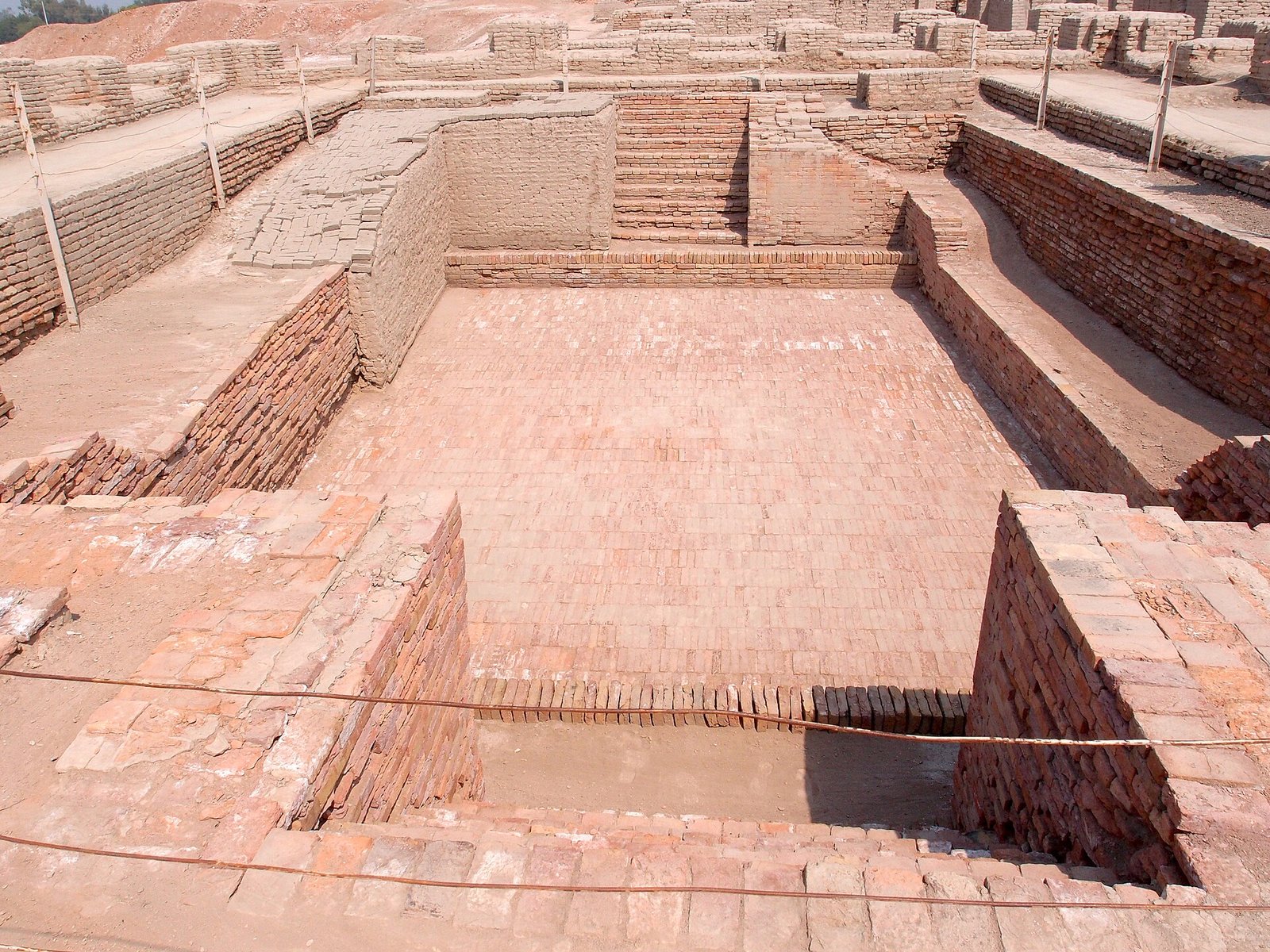
Harappa.com has images of Harappa, Punjab ancient Indus civilization excavations, figurines, seals and other objects - Animal and tree worship: Sacred animals (particularly the humped bull) and sacred trees (especially the pipal, Ficus religiosa) appear frequently on seals. The Great Bath at Mohenjo-daro may have been used for ritual purposes (Ref: Encyclopedia Britannica).
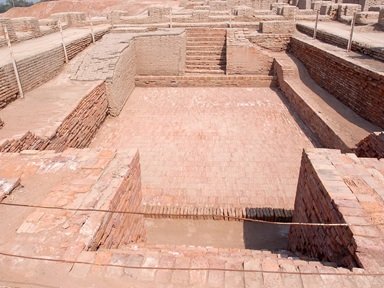
Click above thumbnail image for large size: image by Saqib Qayyum, via Wikimedia Commons. This file is licensed under the Creative Commons Attribution-ShareAlike 3.0 Unported license.
Important Caveat
The identification of the Pashupati seal figure as an early form of Shiva remains debated. Some scholars argue that the yogic posture, association with animals, and possible ithyphallic representation align with later Shaiva characteristics. Others contend that this involves reading later Hindu concepts back into an earlier, distinct civilization whose script remains undeciphered. Some have suggested the figure may resemble a Central Asian or proto-Elamite “lord of animals” deity, or may not represent a deity at all. No scholarly consensus has been reached (Ref: Cambridge Core).
No Temples Confirmed
No building has been positively identified as a temple at any Harappan site, though the Great Bath at Mohenjo-daro may have served a ritual function (Ref: Encyclopedia Britannica).
Period 2: Proto-Indo-Iranian Religious Background
Date: Broadly 2nd millennium BCE
What This Period Represents
Before the Rig Veda was composed, the ancestors of the Indo-Aryan peoples shared a common religious tradition with their Iranian counterparts — known as Proto-Indo-Iranian religion. This is an archaic offshoot of the broader Indo-European religious family. The deities of this tradition are the direct predecessors of the Vedic gods.
The Mitanni Treaty: Key Evidence
The most significant piece of external evidence for this period is a treaty from the 14th century BCE (commonly dated to c. 1380 BCE), discovered in the Hittite archives at Hattusa (modern Boğazköy in central Turkey). The treaty was between the Hittite king Šuppiluliuma I and the Mitanni prince Šattiwaza, and both sides invoked their gods as witnesses to the oath (Ref: World History Encyclopedia).
Among the Hurrian and Mesopotamian deities listed, four names stand out because they are neither Hurrian nor Mesopotamian. In the scribe's cuneiform they read:
| Cuneiform Spelling | Vedic Equivalent | Role |
|---|---|---|
| Mi-it-ra | Mitra | God of oaths, contracts, and alliances |
| Aru-na | Varuna | God of cosmic order and the waters |
| In-da-ra | Indra | Warrior god of storms and rain |
| Na-sa-at-ti-ya | Nasatya (Ashvins) | Divine twin physicians |
These names correspond to the same deities praised in the Rig Veda. The treaty can be securely dated because Hittite chronology is anchored to Egyptian and Assyrian records (Ref: Sigmoid Vedanta). This is the oldest securely dated external attestation of deities corresponding to the Vedic pantheon, demonstrating that these gods were already established and recognized outside South Asia in the 14th century BCE.
Why This Matters
The Mitanni treaty is an independent external attestation that the deities later central to the Rig Veda — Mitra, Varuna, Indra, and the Nasatyas — were already recognized outside South Asia in the 14th century BCE. They belonged to a shared Indo-Iranian heritage that predated their formal appearance in Indian scripture. (Note: because Rig Veda composition dates are ranges and oral transmission complicates the timeline, this evidence should be understood as an independent external confirmation, not as proof that these gods predate the Rig Veda's oral composition.)
The Mitanni treaty provides the oldest securely dated external attestation of deities corresponding to the Vedic pantheon . The gods listed in the treaty (Mitra, Varuna, Indra, Nasatya) were part of a common Indo-Iranian heritage that predates their formal appearance in the Rig Veda
However, these are not the only gods of this period. Scholarly reconstruction of the Proto-Indo-Iranian religion reveals a wider pantheon. Below is a list of the major deities that scholars have identified as belonging to this shared layer| Proto-Indo-Iranian Reconstruction | Vedic Equivalent | Iranian Equivalent | Domain / Role | Mitanni Treaty |
|---|---|---|---|---|
| Mitrás | Mitra | Miθra | God of oaths, contracts, and alliances; associated with the sun and truth. | Yes |
| Váruṇa | Váruṇa | Vouruna | God of cosmic order (rta), the waters, and the sky; a sovereign deity. | Yes |
| Índras | Índra | Indra | Warrior god of storms and rain; a thunderbolt-wielding king of the gods. | Yes |
| Nā́satyā | Nā́satyā (Ashvins) | Nā̊ŋhaiθya | Divine twin horsemen; physicians and healers associated with the dawn. | Yes |
| Hagníš | Agni | Dāšt-āɣni | God of fire; central to the ritual sacrifice, a messenger between gods and humans. | No |
| Dyauš | Dyáuṣ | diiaoš | Sky god; the inherited Proto-Indo-European sky-father, often paired with Earth. | No |
| Bʰagás | Bhaga | Baga | God of wealth, prosperity, and distribution. | No |
| Pr̥tHwíH | Pṛithvī́ | ząm pərəθβīm | Deified Earth; the "broad one," often paired with Sky. | No |
| Aryamā́ | Aryaman | Airiiaman | God of marriage, friendship, and hospitality. | No |
| Hušā́s | Uṣás | Ušå | Dawn goddess; the daughter of Sky. | No |
| Hāpam-nápāts | Apā́m nápāt | apᶏm napāt | "Grandson of the Waters"; a divine being of fire and water. | No |
| YámHas | Yamá | Yima | The first mortal, king of the dead; a twin figure. | No |
| HwaHyúš | Vāyú | Vaiiu | God of the wind. | No |
| Haramati | Arámati | Ārmaiti | Goddess of obedience, piety, and devotion. | No |
A full and definitive list of all reconstructed deities is difficult to provide, as the evidence is scattered and interpretations vary.
eg. Some sources may include additional names like Śarva/Śiva or Soma/Haoma, but these are not part of a universally agreed-upon core list
It's important to remember that in the Iranian tradition (Zoroastrianism), many of these deities were demonized. For example, Indra and Nā́satyā became demons (daeva), while the term asura (Vedic) corresponds to ahura (Iranian), meaning "lord," a title for their supreme god
Period 3: Early Vedic / Rig Vedic Religion
Date: Commonly placed at c. 1500–1000 BCE for the early Vedic / Rig Vedic period
The Texts
The Rig Veda is the oldest of the four Vedas and the earliest literary record of religious life in ancient India. It contains 1,028 hymns distributed across ten books (mandalas), composed in Vedic Sanskrit and preserved through oral transmission across centuries. The exact dates of composition remain debated among scholars, but the range of approximately 1500–1000 BCE is the most widely accepted (Ref: Encyclopedia Britannica).
The 33 Gods (Trayastrimshata: trayas = three + trimshat = thirty)
The Rig Veda and early Vedic texts speak of 33 deities (Sanskrit: Trayastrimshata), a concept developed further in later Vedic and Brahmanical literature.The traditional classification, found in later Vedic texts such as the Shatapatha Brahmana, organizes them into groups based on their cosmic domain. However, there is no single fixed list of these 33 gods in the Rig Veda itself. The grouping fluctuates across different texts.
the Rig Veda does not provide a fixed list of who these 33 are. The systematic classification into 12 Adityas, 11 Rudras, 8 Vasus, and 2 Ashvins appears later in the Brahmanas (specifically the Shatapatha Brahmana, c. 800–600 BCE):| Group | Number | Domain |
|---|---|---|
| Adityas | 12 | Celestial / moral order |
| Rudras | 11 | Atmospheric / life-force |
| Vasus | 8 | Terrestrial / material elements |
| Ashvins (Nasatyas) | 2 | Divine twin healers |
Note: This tripartite structure reflects a broader Indo-European pattern of dividing the cosmos into sky/Celestial, atmosphere, and earth/Terrestrial. The Ashvins (2) are often treated as a separate or marginal category that does not fit neatly into any of the three realms.
Principal Deities
The most important Vedic gods were personifications of natural forces (Ref: Testbook):
- Indra — the most celebrated deity, with over 250 hymns dedicated to him. God of storms, rain, and warfare; wielder of the thunderbolt; slayer of the drought demon Vritra. Called Purandara (breaker of forts).
- Agni — god of fire, second in importance only to Indra. The sacred intermediary between humans and gods, carrying ritual offerings upward. Central to all fire sacrifices (yajnas).
- Soma — both a sacred plant and its intoxicating extract, used in rituals. God of the sacrificial drink.
- Varuna — upholder of Rita (cosmic order), associated with the sky, waters, and moral law. In the earliest hymns, he was the supreme ruler of the cosmos.
- Mitra — god of oaths, friendship, and alliances. Often paired with Varuna as Mitra-Varuna.
- Surya — the sun god, who drives away darkness.
- Vayu — god of the wind.
- Ushas — goddess of dawn, representing the first light of day.
Full List of The 33 Gods of the Rig Vedic Pantheon
☀️ The 12 Adityas (Celestial)
The Adityas are solar deities and sons of Aditi.
The lists of the Adityas vary significantly across texts. The group started as a core of seven or eight in the Rig Veda and later expanded to twelve in the Brahmanas and Puranas, often representing the twelve months of the year.
The table below compares the major versions, including a column indicating which names are considered part of the original seven.
☀ The 12 Adityas (Celestial) - A Comparison of Texts
The lists of the Adityas vary significantly across texts. The group started as a core of seven or eight in the Rig Veda and later expanded to twelve in the Brahmanas and Puranas, often representing the twelve months of the year.
The table below compares the major versions, including a column indicating which names are considered part of the original seven.
| Name | Description / Role | Rig Veda (Core 7) | Taittiriya Brahmana / Aranyaka | Brihadaranyaka Upanishad (List 1) | Brihadaranyaka Upanishad (List 2) | Mahabharata (Adi Parva) | Vishnu Purana | Agni Purana |
|---|---|---|---|---|---|---|---|---|
| Varuna | God of cosmic order and waters | Core 7 | ✓ | ✓ | ✓ | ✓ | ✓ | ✓ |
| Mitra | God of oaths and friendship | Core 7 | ✓ | ✓ | ✓ | ✓ | ✓ | ✓ |
| Aryaman | God of marriage and hospitality | Core 7 | ✓ | ✓ | ✓ | ✓ | ✓ | |
| Bhaga | God of wealth and prosperity | Core 7 | ✓ | ✓ | ✓ | ✓ | ✓ | |
| Amsa | A solar deity | Core 7 | ✓ | ✓ | ✓ | ✓ | ✓ | |
| Daksa | A creator god; father of Aditi | Core 7 | ||||||
| Indra | King of the gods, god of storms | Sometimes included as 7th/8th | ✓ | ✓ | ✓ | ✓ | ✓ | |
| Martanda (rejected) | The 8th son, rejected by Aditi | Rejected | ||||||
| Dhatr | A creator god | ✓ | ✓ | ✓ | ✓ | ✓ | ✓ | |
| Vivasvat (Surya) | The sun god | ✓ | ✓ | ✓ | ✓ | ✓ | ||
| Vidhatr | A creator god; dispenser of rewards | ✓ | ||||||
| Tvastr | God of crafts and smiths | ✓ | ✓ | ✓ | ✓ | ✓ | ||
| Pusan | God of roads and nourisher of cattle | ✓ | ✓ | ✓ | ✓ | |||
| Visnu | A Vedic deity who later becomes a major god | ✓ | ✓ | ✓ | ✓ | ✓ | ||
| Savitr | The impeller; a form of the sun god | ✓ | ✓ | |||||
| Parjanya | God of rain and thunder | ✓ | ✓ | |||||
| Sahasramsu | "Thousand-rayed"; a solar epithet | ✓ | ||||||
| Tapana | "The Scorcher"; a solar epithet | ✓ | ||||||
| Gabhasti | "Rayed"; a solar epithet | ✓ | ||||||
| Ravi | "The Sun"; a solar epithet | ✓ |
Key Observations:
- The Rig Veda mentions seven or eight Adityas, but the core group of six (Varuna, Mitra, Aryaman, Bhaga, Amsa, Daksa) is consistently named.
- The number was fixed at twelve in the Brahmanas, identified with the twelve months of the year.
- The Mahabharata gives several different lists, sometimes including Parjanya and excluding Savitr.
- The Agni Purana includes names like Sahasramsu and Tapana, which are less common.
⛈️ The 11 Rudras (Atmospheric)
The Rudras are storm gods associated with the wind, life-force, and the intermediate realm.
They are generally described as eleven in number, but their names also differ between the Puranas and the Mahabharata.
| Name | Notes |
|---|---|
| Śaṅkara (Śiva) | In some texts, the chief of the Rudras |
| Kapālī | A fierce form of Rudra/Shiva |
| Bhīma | "The Terrible" |
| Vīrabhadra | A fierce form of Shiva |
| Ajaikapāt | "The One-footed Goat" |
| Ahirbudhnya | "The Serpent of the Deep" |
| Tryambaka | "The Three-eyed One" |
| Bhava | "The Existent One" |
| Śiva | An epithet of Rudra |
| Kāla | "Time" |
| Vāmadeva | "The Beautiful God" |
The 11 Rudras (Atmospheric) - A Comparison of Texts
The lists of the eleven Rudras vary across different texts. The table below provides a comparison of the major versions found in the Mahabharata, the Vishnu Purana, the Bhagavata Purana, and other sources.
| Mahabharata (Adi Parva) | Vishnu Purana | Bhagavata Purana (Canto 6) | Bhagavata Purana (Canto 3) | Matsya Purana | Notes / Other Names |
|---|---|---|---|---|---|
| Mrigavayadha | Aja | Raivata | Manyu | Kapali | Also called Mrigavyadha |
| Sarpa | Ekapada (Ekapat) | Aja | Manu | Pingala | Ajaikapat / Ajaikapad |
| Niriti | Ahirbudhnya | Bhava | Mahinasa | Bhima | Ahirbudhnya / Ahivradhna |
| Ajaikapat | Tvashtr | Bhima | Mahan | Virupaksa | Ajaikapat |
| Ahivradhna | Rudra | Vama | Siva | Vilohita | Ahirbudhnya / Ahi Budhnya |
| Pinaki | Hara | Ugra | Rtadhvaja | Ajesha | Pinakin |
| Dahana | Sambhu | Vrsakapi | Ugrareta | Shasana | Also called Dahana |
| Iswara | Tryambaka | Ajaikapat | Bhava | Shasta | Isvara / Ishana |
| Kapali | Aparajita | Ahirbradhna | Kala | Shambhu | Kapalin |
| Sthanu | Isana | Bahurupa | Vamadeva | Chanda | Sthanu |
| Bharga | Tribhuvana | Mahan | Dhrtavrata | Dhruva | Also called Bharga |
Key Observations:
- The Brihadaranyaka Upanishad defines the eleven Rudras not by name, but as the ten vital breaths (pranas) and the mind (atman) as the eleventh.
- The Bhagavad Gita (10.23) states that among the Rudras, Sankara is the greatest.
- Many of these names are well-known epithets of the god Shiva.
🌍 The 8 Vasus (Terrestrial)
The Vasus are earth deities associated with the material elements.
They are generally eight in number, but their names are listed differently in various texts. The table below compares the two most prominent versions: the one from the Brihadaranyaka Upanishad and the more common list from the Mahabharata, which are generally treated as equivalents by scholars.
| Brihadaranyaka Upanishad Name | Meaning (Brh. Upan.) | Mahabharata Name | Meaning (Mahabharata) | Notes |
|---|---|---|---|---|
| Agni | Fire | Anala (also called Agni/Pavaka) | "Living" / Fire | Represents the element of fire |
| Prithvi | Earth | Dharā | "Support" / Earth | Represents the element of earth |
| Vāyu | Wind / Air | Anila | Wind | Represents the element of wind |
| Antariksha | Sky / Atmosphere | Aha | "Pervading" / Atmosphere | Represents the intermediary space |
| Āditya | The Sun (eternal) | Pratyūsha | Pre-Dawn / Sun | Symbolizes the dawn or the sun |
| Dyaus | Heaven / Sky | Prabhāsa | "Shining Dawn" / Sky/Ether | Associated with the heavens or splendor |
| Chandramas | The Moon | Soma | The Moon / Soma-plant | Represents the moon |
| Nakshatrani | The Stars | Dhruva | "Motionless" / The Pole Star | Represents the fixed celestial point |
Note: The Mahabharata list is more common in later texts, though sometimes Āpa (water) appears in place of Aha . The Vishnu Purana equates Prabhāsa with the lights of the 27 Nakshatras and Dhruva with space, effectively giving Dhruva the role of Aha when water replaces it . A simpler list from some later sources includes: Apa (water), Dhruva (North Star), Soma (moon), Dhara (earth), Anila (wind), Anala (fire), Prabhasa (dawn), and Pratyusa (light)
🩺 The 2 Ashvins (Divine Twins)
The Ashvins, also known as the Nasatyas, are the divine twin horsemen and the physicians of the gods. They are consistently counted as two and are always referred to in the dual.
| Name | Notes |
|---|---|
| Nāsatya | One of the twins, meaning "true" or "helpful" |
| Dasra | The other twin, meaning "enlightened giving" |
Form of Worship
Vedic religion centred on yajna — ritual fire sacrifice. Hymns were recited, offerings were made into the sacred fire, and the gods were invoked through precise ritual procedures performed by priests. This was a religion of sound and sacrifice, not of images.
No Temples, No Idols, No Iconography
This is a critical point for understanding the development of Hindu deity worship. In the Rig Vedic period, there is no evidence of temple construction, idol worship, or representational iconography for the Vedic gods. As Encyclopedia Britannica notes, there is no trace in Vedic times of Indra, Varuna, Agni, or Ushas being represented in wood or stone, or of their requiring houses or temples. Later Vedic religion similarly centred on elaborate fire sacrifices (yajnas), not on image veneration (Testbook). Worship was conducted through oral hymns and fire offerings, not through images or shrines.
Period 4: Late Vedic / Upanishadic
Date: c. 1000–500 BCE
What Changed
The Late Vedic period saw a shift from the external fire sacrifices of the Rig Vedic era toward inward, philosophical speculation. The Brahmanas (ritual texts), Aranyakas (“forest texts”), and the Principal Upanishads were composed during this period. The centre of religious activity gradually shifted eastward into the Gangetic plain.
Key Developments
- Brahman and Atman: The Upanishads introduced the concepts of Brahman (the ultimate, unchanging reality underlying all existence) and Atman (the inner self or soul). The central insight — Tat tvam asi (“That thou art”) — identified the individual self with the universal reality.
- Karma and Samsara: The doctrines of karma (action and its consequences across lifetimes) and samsara (the cycle of rebirth) were first systematically articulated in the Upanishads, particularly the Brihadaranyaka Upanishad (c. 700 BCE), one of the oldest (Encyclopedia Britannica).
- Rudra → Shiva transition: The Vedic god Rudra (a fierce, ambivalent deity of storm and healing) began to absorb characteristics that would later define Shiva. The Shatarudriya hymn of the Yajurveda praises Rudra with many epithets that become associated with Shiva in later tradition.
- Early technical use of “yoga”: The term yoga (from the Sanskrit root yuj, “to yoke”) appears in an early technical, spiritual sense in the Katha Upanishad, commonly dated to approximately the 5th–3rd century BCE. Verse 6.11 states: “This firm holding of the senses is what is considered to be Yoga.” The root word appears earlier in non-technical senses (e.g., a yoke or chariot harness); the Katha Upanishad is one of the earliest texts to use it as a disciplined spiritual practice (Oxford Centre for Hindu Studies, SevaCart). Note: the Katha Upanishad's dating places it transitional between Periods 4 and 5.
Significance
This period laid the philosophical foundation for all later Hindu thought. The concepts of Brahman, Atman, karma, and samsara became the shared intellectual framework within which later Puranic, Tantric, and yogic traditions developed. However, there were still no temples, no idols, and no asana poses in this period — the religious focus was on ritual, meditation, and philosophical inquiry.
Period 5: Second Urbanization / Shramana
Date: c. 600–200 BCE
What This Period Represents
The second urbanization of India (c. 600 BCE onward) saw the rise of cities, states, and new religious movements that challenged Vedic orthodoxy. The most significant of these were the Shramana traditions — ascetic movements that rejected Vedic authority, ritual sacrifice, and the caste system in favour of meditation, ethical living, and the pursuit of liberation.
Political Context: The Dynasties of Magadha
The political backdrop to the Shramana movements was the rise of Magadha (modern-day Bihar) as the dominant kingdom of northern India. A succession of dynasties ruled from its capital, Pataliputra:
- Haryanka Dynasty (c. 544–413 BCE): Founded by Bimbisara, under whose reign Magadha began its expansion. Both the Buddha and Mahavira were contemporaries of the Haryanka rulers Bimbisara and Ajatashatru (Ref: Testbook).
- Shishunaga Dynasty (c. 413–345 BCE): Founded by Shishunaga, a minister who overthrew the last Haryanka ruler. The capital was temporarily shifted to Vaishali before returning to Pataliputra.
- Nanda Dynasty (c. 345–322 BCE): A short-lived but immensely wealthy dynasty overthrown by Chandragupta Maurya.
- Maurya Dynasty (322–185 BCE): Founded by Chandragupta Maurya, this was the first empire to unify most of the Indian subcontinent. Under Ashoka (r. c. 268–232 BCE), Buddhism received state patronage and spread across Asia after the Kalinga War (c. 261 BCE) (Ref: Human Saga).
These dynasties provided the political stability and urban infrastructure within which the Shramana movements — Buddhism and Jainism — could spread. A Mauryan-period terracotta Mother Goddess figurine (c. 300 BCE) also survives from this era, showing that goddess and fertility imagery continued in historical India, though this should not be taken as proof of a direct unbroken cult lineage from the Indus Valley Civilization.
Key Developments
- Buddhism: Siddhartha Gautama (the Buddha, c. 5th century BCE) taught the Four Noble Truths and the Eightfold Path as a middle way between indulgence and extreme asceticism.
- Jainism: Mahavira (c. 6th–5th century BCE) systematized Jain teachings centred on ahimsa (non-violence), tapas (austerity), and strict asceticism. Jain and Buddhist ascetic traditions contributed significantly to early yoga-like disciplines (Oxford Centre for Hindu Studies).
- Early yoga concepts: Buddhist and Jain meditation techniques, alongside Upanishadic contemplative practices, contributed to the gradual systematization of yoga as a discipline of mental and physical training. The Bhagavad Gita, which synthesizes Vedic ritual, Upanishadic philosophy, and devotional (bhakti) worship of a personal god (Krishna), is commonly dated broadly to c. 2nd century BCE – 2nd century CE (with debate), placing it in Period 6 (Superprof).
Significance for Deity History
The Shramana movements shifted religious authority away from Brahmin priests and Vedic ritual toward individual spiritual practice. While Buddhism and Jainism are separate religions, they profoundly influenced Hinduism — particularly the development of yoga, meditation, and the later Bhakti emphasis on personal devotion over ritual sacrifice. The concept of a personal god (ishta-devata) began to emerge in this environment.
Period 6: Classical / Epic-Puranic
Date: c. 200 BCE – 500 CE
What Changed
This period marks a fundamental transformation in Hindu religious practice. The nature gods of the Vedic period gradually gave way to the major deities of classical Hinduism — gods with names, forms, stories, temples, and iconography. This is the period in which the gods most people associate with Hinduism today — Shiva, Vishnu, Durga, Ganesha, Krishna, and Rama — took recognizable shape.
Key Developments
- The Epics: The Ramayana and the Mahabharata (including the Bhagavad Gita, whose final composition is commonly placed in this period, c. 200 BCE – 200 CE) were finalized. These texts gave the gods narrative form — Rama as the ideal king and avatar of Vishnu, Krishna as divine teacher and avatar, and Shiva as the supreme ascetic (Superprof).
- Patanjali's Yoga Sutras: Broadly dated between c. 2nd century BCE and 4th/5th century CE (dating debated), the Yoga Sutras systematized yoga into an eight-limbed path (ashtanga): yama, niyama, asana, pranayama, pratyahara, dharana, dhyana, samadhi. Here, “asana” means simply a seated posture for meditation — not the physical postures of later hatha yoga (Superprof).
- The Trimurti: By the time the major Puranas began to be compiled, Brahma (creation), Vishnu (preservation), and Shiva (dissolution) had been organized into the cosmic trinity — three inseparable phases of the universal cycle.
- Shaivism and Vaishnavism: The Epic and Early Puranic period saw the rise of the great devotional traditions (Bhakti) centred on Shiva and Vishnu. The Gupta period (c. 320–550 CE) and the post-Gupta era are often described as a golden age for this development.
- Temple Architecture and Iconography: The Udayagiri caves (early 5th century CE) preserve some of the earliest detailed iconography of Vishnu, Shiva, and Durga as Mahishasuramardini (slayer of the buffalo demon). From this period onward, temples, sculpted idols, and formalized deity imagery became central to Hindu worship.
- South Indian traditions: The Sangam period (c. 300 BCE – 300 CE) in Tamil South India produced its own distinct religious traditions, including the worship of Murugan (later identified with Skanda/Kartikeya), a major deity of the Tamil landscape who would later be absorbed into the Puranic pantheon.
The Major Gods of the Classical Puranic Period
| Deity | Role | Consort | Vahana (Vehicle) | Key Attributes |
|---|---|---|---|---|
| Brahma | Creation | Saraswati | Hamsa (swan) | Four heads, four arms, Vedas, kamandalu (water pot) |
| Vishnu | Preservation | Lakshmi | Garuda (eagle) | Four arms, conch, discus (Sudarshana), mace, lotus |
| Shiva | Destruction / Dissolution | Parvati | Nandi (bull) | Third eye, trident (trishula), damaru (drum), crescent moon |
The Ten Avatars of Vishnu (Dashavatara)
Vishnu is traditionally said to have ten principal incarnations (avatars), which appear in different cosmic ages to restore cosmic order (dharma).
| Avatar | Form | Role / Significance |
|---|---|---|
| Matsya | Fish | Saved Manu from the great deluge |
| Kurma | Tortoise | Supported Mount Mandara during the churning of the ocean |
| Varaha | Boar | Rescued the earth goddess (Bhudevi) from the demon Hiranyaksha |
| Narasimha | Half-man, half-lion | Killed the demon Hiranyakashipu; protects devotees |
| Vamana | Dwarf | Subdued the demon king Bali; restored Indra's sovereignty |
| Parashurama | Brahmin with an axe | Destroyed the Kshatriya warrior class twenty-one times |
| Rama | Prince of Ayodhya | Hero of the Ramayana; upholder of dharma and ideal king |
| Krishna | Cowherd prince / charioteer | Hero of the Mahabharata; teacher of the Bhagavad Gita |
| Buddha | Enlightened teacher | Some traditions include Buddha as an avatar to restore dharma |
| Kalki | Warrior on a white horse | Future avatar who will appear at the end of the Kali Yuga |
Major Forms of the Goddess (Devi)
The Goddess (Devi) is worshipped in numerous forms, ranging from benevolent to fierce. The Devi Mahatmyam (5th–6th century CE) describes her as the supreme cosmic force.
| Form | Role | Consort | Vahana (Vehicle) | Key Attributes |
|---|---|---|---|---|
| Durga | Warrior goddess | Shiva | Lion / Tiger | Eight or ten arms; slayer of Mahishasura (buffalo demon) |
| Parvati | Gentle goddess; daughter of the mountains | Shiva | Lion | Mother of Ganesha and Skanda; embodies marital devotion |
| Lakshmi | Goddess of wealth and prosperity | Vishnu | Owl | Four arms, lotus, gold coins |
| Saraswati | Goddess of learning, music, and arts | Brahma | Hamsa (swan) | Veena (lute), books, rosary |
Other Major Deities
| Deity | Role | Family | Vahana (Vehicle) | Key Attributes |
|---|---|---|---|---|
| Ganesha | Remover of obstacles; lord of beginnings | Son of Shiva & Parvati | Mooshika (mouse) | Elephant head, broken tusk, modak, laddus |
| Skanda / Kartikeya | God of war | Son of Shiva & Parvati | Peacock | Six heads (sometimes), spear (vel) |
| Hanuman | Monkey god; devoted servant of Rama | Son of Vayu | - | Mace, mountain, fiery tail; embodies devotion (bhakti) |
| Surya | Sun god | Son of Aditi | Seven-horsed chariot | Radiant, lotus, drives away darkness |
Connection to Yoga
Patanjali's Yoga Sutras defined “asana” as a stable, comfortable seated posture for meditation (Sutra 2.46: sthira sukham asanam). This is not the physical postural system of later centuries. The deity imagery that later yoga traditions draw from begins to emerge here through temple iconography, but named asanas linked to deities do not yet exist in this period.
Period 7: Early Medieval / Puranic Peak
Date: c. 500–900 CE
What This Period Represents
The early medieval period saw the full flowering of Puranic Hinduism. The major Puranas were compiled and expanded, temple building accelerated across India, and the classical pantheon of deities took its familiar form with standardized iconography.
Key Developments
- The Devi Mahatmya (c. 400–600 CE): This text, also known as the Durga Saptashati or Chandi Path, is the most important early text of Shaktism. Extracted from the Markandeya Purana, it contains 700 verses arranged into 13 chapters and describes the Goddess as the supreme power and creator of the universe (Ref: thefreedictionary). It details her battles against the demons Mahishasura, Shumbha, and Nishumbha, establishing her as the protector of cosmic order (Ref: inlibris).
- The Devi Tradition (Shaktism): The goddess Durga emerged prominently in the early centuries CE, particularly through the Devi Mahatmyam (Glory of the Goddess), commonly dated around the 5th–6th century CE, which established her as the supreme divine feminine principle. This text became foundational for Shaktism.
- The Devi Upanishad (c. 9th–14th century CE): This Shakta Upanishad, attached to the Atharvaveda, explicitly states that the Goddess is Brahman, and from her arise Prakriti (matter) and Purusha (consciousness) (Ref: Wikipedia). It represents the philosophical synthesis of Vedanta and Shaktism, emphasizing Mahadevi as the supreme cosmic force.
- The Tamil Bhakti Movement — the earliest Bhakti tradition: Beginning around the 6th century CE, a powerful devotional movement emerged in Tamil South India, led by two groups of poet-saints:
- The Alvars (literally "those immersed in devotion"): 12 Vaishnava saints who composed Tamil devotional hymns to Vishnu and his avatars (Krishna, Rama). Their collected hymns, the Nalayira Divya Prabandham (4,000 Tamil hymns), came to be called the "Tamil Veda." They sang at 108 sacred Vishnu temples (Divya Desams) across South India (Ref: Testbook, Human Saga).
- The Nayanars: 63 Shaiva saints devoted to Shiva, active between the 6th and 9th centuries CE. Their hymns form the Tirumurai (12 volumes), with the first seven volumes known as the Tevaram, composed by Appar, Sundarar, and Tirujnana Sambandar. Their hagiographies were later compiled in the Periyapuranam by Sekkizhar (12th century CE) (Ref: Testbook, MentorsDaily).
- Importance of Tamil Bhakti: The Alvars and Nayanars were the earliest Bhakti movement in India, predating the North Indian Bhakti movement by approximately 800 years. They established temple-based devotion to Shiva and Vishnu as a mass popular movement, promoted the building of temples, and their hymns are still sung in South Indian temples today. The only female Alvar, Andal, is one of the most celebrated poet-saints in Hindu tradition (Ref: MentorsDaily).
- Shankara (c. 8th century CE): The philosopher Adi Shankara systematized Advaita Vedanta (non-dualism) and established four monastic centres (mathas) across India, contributing to the consolidation of Hindu intellectual life. The Smarta tradition of worshipping five principal deities (Vishnu, Shiva, Durga, Surya, and Ganesha) is traditionally associated with Shankara and later Advaita practice.
- Yogini temples: The Chausath Yogini (64 Yogini) temples were built between the 9th and 12th centuries CE, particularly within Tantric and Shaiva traditions. The Hirapur Yogini Temple in Odisha, dated to the 9th century CE and attributed to the Bhaumakara dynasty (traditionally said to have been built by Queen Hira), is one of the finest surviving examples. Its outer circular wall contains 60 Yogini niches, with additional figures in the central pavilion — four remaining Yoginis and four Bhairavas — bringing the total to 64, with a central Shaiva presence (Ref: Vajiramandravi, DharmaRenaissance).
- Epigraphical Evidence: Between the 7th and 13th centuries CE, many inscriptions commissioned by rulers formalized grants to powerful forms of the Goddess, plotting the consolidation of political authority through patronage of the Goddess cult (Ref: ochs.org.uk).
Key Deity Introduced in This Period
Only one major new deity emerges in this period: Kali, as a fierce form of the Goddess. While Durga appears in the Devi Mahatmyam, Kali is the terrifying emanation of her rage, established as a distinct and powerful goddess in her own right during this period.
| Form of Devi | Role / Significance | Key Attributes |
|---|---|---|
| Kali | Fierce goddess of time and destruction; emanation of Durga's rage | Dark complexion, garland of skulls, severed head, standing on Shiva |
- The Devi Mahatmya (c. 400–600 CE) contains the earliest textual reference to Kali as the slayer of demons and an emanation of Durga's rage.
- Kali's iconography crystallized during the Puranic period (3rd–7th century CE).
- The first stone image of Kali on Shiva (2-armed) appears at Hirapur in 864 CE.
- Chola bronze images of Kali date from the 10th century CE onward.
- Kali is described as a "terrific manifestation of Durga" in the Devi Mahatmya.
Significance for Deity History
This is the period where the classical Hindu pantheon fully crystallized. The Tamil Bhakti movement was the first to make devotion to personal gods (Shiva and Vishnu) a mass popular practice, establishing the template that would later spread across North India. The Devi Mahatmyam elevated the Goddess to supreme status. Temple iconography became standardized, providing the visual vocabulary that later yoga asana traditions would draw on.
Note: Shiva and Vishnu are not new deities in this period — they were already established in Period 6. What is new in Period 7 is:
- The crystallization of their worship through the Tamil Bhakti movements (Alvars for Vishnu, Nayanars for Shiva)
- The standardization of their iconography in temples
- The Devi Mahatmyam elevating the Goddess to supreme status
Period 8: Medieval Tantric
Date: c. 900–1400 CE
What This Period Represents
Tantric traditions, which had roots in earlier centuries, became a dominant force in Indian religious life during this period. Tantra introduced new forms of deity worship, esoteric practices, and the worship of fierce goddess forms. It also produced the earliest known hatha yoga texts.
Key Developments
- The Ten Mahavidyas: The group of ten goddesses known as the Dasa Mahavidyas — Kali, Tara, Tripura Sundari (Shodashi), Bhuvaneshwari, Bhairavi, Chhinnamasta, Dhumavati, Bagalamukhi, Matangi, and Kamala — took shape across multiple medieval Shakta and Tantric texts, including the Mahabhagavata Purana, Kalika Purana, Todala Tantra, Mundamala Tantra, and Tantrasara. They represent ten manifestations of the Divine Mother as supreme wisdom and power (Ref: Adishaktism).
- Devi Bhagavata Purana (c. 11th–12th century CE): A key text of Shaktism, this Purana is dedicated to the Goddess (Devi) as the supreme being. Its final nine chapters (31–40) of the seventh skandha are known as the Devi Gita, which became a central text of Shaktism, presenting the Goddess as the supreme Brahman (Ref: graphsearch). It provides extensive theological and mythological material on the Goddess and her various forms, including the Mahavidyas.
- Kalika Purana (10th–11th century CE): An important Upapurana focused on the worship of Kali and the goddess tradition, particularly influential in Assam and eastern India. It provides detailed iconographic descriptions of goddess forms.
- Textual Codification of the Mahavidyas: The group became prominent between the 10th and 12th centuries CE (Ref: shodhganga). The Todala Tantra and other Tantric texts provide detailed descriptions of their iconography and worship.
- Iconographic Traditions: The Mahavidyas are often shown as a group in goddess temples, painted on the interior walls surrounding the inner shrine. Examples include the Kali-Bari temple in Shimla, the Naina Devi temple in Bilaspur, and the Jwalamukhi Devi temple, which prominently depicts them on the walls of a large pavilion (Ref: shodhganga).
- Mythological Origins of the Mahavidyas: According to Puranic tradition, when Sati insisted on attending her father Daksha's sacrifice against Shiva's wishes, she assumed ten ferocious forms (the Mahavidyas) that surrounded Shiva and forced him to allow her to go (Ref: archive.org).
- Amṛtasiddhi (11th century CE): An 11th-century text composed in a Tantric Buddhist context, containing some of the earliest known descriptions of practices later associated with hatha yoga, including techniques for preserving bindu (vital essence). Scholars James Mallinson and Péter-Dániel Szántó have shown that this text was first transmitted within Buddhist communities, not Hindu ones, revealing hatha yoga's partly Buddhist origins (Ref: Rubin Museum, Amrita Yoga).
- Dattātreyayogaśāstra (13th century CE): The oldest text to systematically present hatha yoga as a distinct system. It teaches an eight-limbed yoga similar to Patanjali's, combined with mudras and bandhas. It is the earliest text to organize yogic techniques under the name “hatha yoga” (Ref: Amrita Yoga).
- The Nāth tradition: The Nāth yogis, traditionally associated with the sage Matsyendranath and his disciple Gorakshanath, were influential in the development of medieval hatha yoga. The Nāth tradition preserved and transmitted many of the physical and energetic techniques that would later appear in hatha yoga manuals.
- Kali iconography: The depiction of Kali standing or dancing on the prostrate body of Shiva became standardized during this period, symbolizing the supremacy of Shakti (divine feminine energy) and the dynamic power of the Goddess over the still consciousness of Shiva.
The Ten Mahavidyas (Dasa-Mahavidyas)
The Mahavidyas are considered Tantric in nature. Shaktas believe that "the one Truth is sensed in ten different facets; the Divine Mother is adored and approached as ten cosmic personalities" (Ref: Wikipedia). They represent a spectrum of feminine divinity, from horrific goddesses at one end to the ravishingly beautiful at the other.
| Mahavidya | Role / Significance | Notes |
|---|---|---|
| Kali | The ultimate form of Brahman; "Devourer of Time" | Supreme Deity of Kalikula systems |
| Tara | Goddess as Guide and Protector; offers ultimate knowledge | Also known as Neel Saraswati |
| Tripura Sundari (Shodashi) | "Beautiful in the Three Worlds" | Supreme Deity of Srikula systems; the "Tantric Parvati" |
| Bhuvaneshwari | Goddess as World Mother; whose body is the cosmos | Represents world-mindedness and protection |
| Bhairavi | The Fierce Goddess | Guardian deity of the three worlds |
| Chhinnamasta | The self-decapitated Goddess | Symbolises a detached life; drinks blood from her own severed throat |
| Dhumavati | The Widow Goddess; Goddess of death | Represents the inauspicious and transformative |
| Bagalamukhi | Goddess who paralyzes enemies | Represents the power to stun or silence |
| Matangi | The "Tantric Saraswati" | Prime Minister of Lalita in Srikula systems |
| Kamala | The Lotus Goddess; the "Tantric Lakshmi" | Represents prosperity and spiritual fulfillment |
Significance for Yoga History
This is the period where hatha yoga as a distinct system of physical and energetic practices was born. Crucially, its earliest texts emerged from a Buddhist tantric context, not a purely Hindu one. The techniques of mudras, bandhas, and physical postures developed here would later be codified in the better-known hatha yoga manuals of Period 9.
The Śākta traditions contributed significantly to the development of haṭhayoga, with distinctive techniques formalized in Sanskrit texts from the eleventh century onwards (Ref: ochs.org.uk). The yogic postures and meditative practices associated with the Mahavidyas are part of the esoteric Tantric tradition, not the earlier Vedic or Puranic layers.
Period 9: Late Medieval / North Indian Bhakti & Hatha Codified
Date: c. 1400–1700 CE
What This Period Represents
This period saw two major parallel developments: the North Indian Bhakti movement (distinct from the earlier Tamil Bhakti of Period 7) and the codification of hatha yoga into the texts that are still studied today.
The North Indian Bhakti Movement
While the Tamil Bhakti movement (6th–9th century CE) was the earliest, the North Indian Bhakti movement of this period spread devotional worship across the Hindi-speaking regions and beyond. Key figures included:
- Kabir (15th century): A poet-saint who rejected both Hindu and Muslim orthodoxies, teaching a formless divine reality.
- Mirabai (16th century): A Rajput princess-devotee of Krishna, whose devotional songs are still widely sung.
- Tulsidas (16th–17th century): Author of the Ramcharitmanas, the Hindi retelling of the Ramayana that made Rama's story accessible to the common people.
- Chaitanya (16th century): A Bengali saint who popularized ecstatic devotion (kirtan) to Krishna.
The North Indian Bhakti movement shared with the earlier Tamil Bhakti an emphasis on personal devotion over ritual, but it developed its own distinct forms, languages, and saint lineages (Ref: Deepmentor).
This movement reached its zenith around 1700 CE, when devotional poetry, temple-building, and mass kirtan (ecstatic chanting) became defining features of North Indian religious life.Hatha Yoga Codified
- Hatha Yoga Pradipika (15th century CE): Written by Swami Swatmarama, this is the most widely studied classical hatha yoga text. It describes a limited number of asanas (commonly cited as approximately 15), along with pranayama, mudras, and bandhas. The asanas are primarily seated postures for meditation and energy work — not the athletic postures of modern yoga (Centre for Yoga Studies).
- Gheranda Samhita (late 17th century CE): One of the four foundational hatha yoga texts. It describes 32 asanas and additional cleansing techniques (shatkarmas). Scholars debate its exact date, with estimates ranging from the 13th to the 17th century; the earliest surviving manuscript dates to 1802 (Yoga Vidya).
Significance for Yoga History
The hatha yoga texts of this period represent the codification of a physical yoga practice that had been developing since Period 8. However, the number of asanas described is small — roughly 15 in the Hatha Yoga Pradipika and 32 in the Gheranda Samhita — and they are primarily seated or reclining postures designed for meditation and energy direction, not the standing poses, balances, and flows of modern postural yoga.
In parallel with hatha yoga's codification, the Bhakti movement reached its zenith around 1700 CE, making personal devotion to deities like Krishna, Rama, and Shiva a mass popular practice across North India. This devotional aspect also permeated Tantric traditions, where the Goddess was worshipped with intense personal devotion alongside esoteric ritual.
Period 10: Early Modern / Colonial & Modern Postural Yoga
Date: c. 1700–1947 CE
What This Period Represents
The colonial period saw Hindu reform movements, the encounter with Western physical culture, and the beginnings of modern postural yoga — the system that would eventually become “yoga” as the world knows it today.
Key Developments
- Brahmo Samaj (1828): Founded by Raja Ram Mohan Roy, this reform movement sought to purify Hinduism of idolatry and caste prejudice, drawing on Upanishadic monotheism and engaging with Western thought.
- Arya Samaj (1875): Founded by Swami Dayananda Saraswati, this movement advocated a return to the Vedas as the sole authority, rejecting later Puranic and idol-based practices.
- Surya Namaskar (popularized 1920s): The modern sequence of Surya Namaskar (Sun Salutation) was popularized in the 1920s by Bhavanrao Shrinivasrao Pant Pratinidhi, the Rajah of Aundh, who described it in his 1928 book The Ten-Point Way to Health: Surya Namaskars. Pant Pratinidhi himself claimed it was an existing Marathi tradition, not his invention. The sequence was not recorded in any hatha yoga text before the 19th century (Yoga.com).
- Krishnamacharya and the Mysore Palace (1930s–1950s): Tirumalai Krishnamacharya, often called the “father of modern yoga,” was sponsored by the Maharaja of Mysore (Krishnaraja Wadiyar IV) to teach yoga at the Jaganmohan Palace grounds from the early 1930s. Krishnamacharya blended traditional hatha yoga texts, Patanjali's Yoga Sutras, Indian wrestling exercises, Western gymnastics, and British physical culture movements. This fusion created the dynamic, physical style of yoga that became the foundation of modern postural yoga. His students included B.K.S. Iyengar, K. Pattabhi Jois, and T.K.V. Desikachar, who would carry his teachings worldwide (Fitness CF, Ashtanga Philippa).
- Standing poses added: Many of the standing poses now common in yoga — such as the warrior poses (Virabhadrasana), triangle (Trikonasana), and others — were developed or introduced by Krishnamacharya during this period, influenced by Western gymnastics and Indian physical culture traditions. A pre-modern manuscript, the Haṭhābhyāsapaddhati, documents dynamic sequences and postures that prefigure some modern asanas, suggesting the tradition was not purely a 20th-century invention (Fitness CF).
Significance for Yoga History
This is the period where modern posture-dominant yoga was shaped. The asanas described in medieval hatha yoga texts (Period 9) numbered fewer than 32 and were primarily seated postures. The hundreds of standing, balancing, and flowing poses that characterize modern yoga are largely a product of this period's fusion of Indian traditions with Western physical culture. This is a critical distinction: while yoga's philosophical roots are ancient, its postural form is largely modern.
Period 11: Modern / Global
Date: 1947–present
What This Period Represents
Following Indian independence, yoga was systematized, exported, and transformed into a global phenomenon. The teachers trained by Krishnamacharya established their own schools and spread yoga worldwide.
Key Developments
- B.K.S. Iyengar — Light on Yoga (1966): Iyengar, a student of Krishnamacharya, published Light on Yoga, which became the most influential modern yoga manual. It codified and illustrated hundreds of asanas with detailed alignment instructions, many of which had no precedent in pre-modern texts. The book introduced poses such as Ardha Chandrasana (Half Moon Pose) to a wide audience as part of a systematic postural curriculum (Yoga.com).
- K. Pattabhi Jois — Ashtanga Vinyasa Yoga: Jois, another student of Krishnamacharya, systematized the dynamic, breath-synchronized flowing style known as Ashtanga Vinyasa Yoga (or “Mysore style”), which became the basis for modern Power Yoga and Vinyasa Flow (Ashtanga Philippa).
- Global spread: From the 1960s onward, yoga spread across Europe, America, and eventually worldwide. The number of named asanas expanded dramatically, with modern yoga schools cataloguing hundreds of postures — far beyond the 15–32 described in medieval hatha yoga texts.
- Deity-named asanas: Many asanas bearing the names of Hindu deities — such as Hanumanasana (the splits, named for Hanuman's leap), Natarajasana (Lord of the Dance pose, named for Shiva as Nataraja), Virabhadrasana (Warrior pose, named for Virabhadra, a fierce form of Shiva), and Surya Namaskar (Sun Salutation, addressed to Surya) — draw their names and inspiration from the mythology and iconography of Periods 6–8, but were formalized as named postures in modern postural yoga (Periods 10–11), not in the Puranic or medieval periods themselves.
Significance
Modern global yoga is the product of an evolving tradition with roots in ancient philosophy, medieval practice, and 20th-century innovation. However, the specific postures, sequences, and styles most people practice today are largely modern creations. The philosophical concepts (Period 4), devotional traditions (Periods 5, 7, 9), and meditation systems (Periods 4, 6) are ancient. The physical postural practice in its current form is primarily a product of the 20th century, building on but greatly expanding the small corpus of medieval hatha yoga asanas.
Summary Timeline
| Period | Date | Key Deities / Focus | Form of Worship | Yoga Relevance |
|---|---|---|---|---|
| 1. Indus Valley / Pre-Vedic | c. 2600–1900 BCE | Mother Goddess (debated), Pashupati / “Proto-Shiva” (debated) | Fertility cults, animal/tree/stone worship | Pashupati seal shows cross-legged seated posture (interpretation debated) |
| 2. Proto-Indo-Iranian | 2nd millennium BCE | Mitra, Varuna, Indra, Nasatyas | Shared Indo-Iranian tradition (pre-Vedic) | None |
| 3. Early Vedic / Rig Vedic | c. 1500–1000 BCE | Indra, Agni, Soma, Varuna, Surya, Vayu, Ushas (33 gods) | Fire sacrifice (yajna), hymns — no temples or idols | None — no temples, no poses, no iconography |
| 4. Late Vedic / Upanishadic | c. 1000–500 BCE | Brahman, Atman; Rudra → Shiva transition begins | Ritual + philosophical inquiry; meditation | First use of word “yoga” (Katha Upanishad, c. 5th–3rd BCE) |
| 5. Second Urbanization / Shramana | c. 600–200 BCE | Buddha, Mahavira; early personal deity concepts | Meditation, asceticism, ethical living | Early systematic yoga concepts in Buddhist/Jain traditions |
| 6. Classical / Epic-Puranic | c. 200 BCE – 500 CE | Shiva, Vishnu, Brahma (Trimurti); Krishna, Rama; Durga | Temples, icons, Bhakti, Puranas | Patanjali Yoga Sutras; “asana” = seated meditation posture |
| 7. Early Medieval / Puranic Peak | c. 500–900 CE | Devi/Durga (Devi Mahatmyam); Tamil Bhakti saints (Alvars, Nayanars) | Temple worship, devotional hymns, Bhakti | Deity iconography standardized; no named asanas yet |
| 8. Medieval Tantric | c. 900–1400 CE | Kali, Ten Mahavidyas; Tantric goddess forms | Tantric worship, esoteric practices, Yogini temples | Oldest hatha yoga text: Amṛtasiddhi (11th CE, Buddhist); Dattātreyayogaśāstra (13th CE) |
| 9. Late Medieval / North Indian Bhakti & Hatha | c. 1400–1700 CE | Krishna (Mirabai, Chaitanya); Rama (Tulsidas) | North Indian Bhakti, kirtan, devotional poetry | Hatha Yoga Pradipika (15th CE, ~15 asanas); Gheranda Samhita (17th CE, 32 asanas) |
| 10. Early Modern / Colonial | c. 1700–1947 CE | Reform movements; deity worship continues | Brahmo Samaj, Arya Samaj; physical culture fusion | Surya Namaskar (1920s); Krishnamacharya standing poses (1930s–50s) |
| 11. Modern / Global | 1947–present | Deity-named asanas: Nataraja, Hanuman, Virabhadra, Surya | Global yoga culture; diverse modern schools | Iyengar Light on Yoga (1966); Ashtanga Vinyasa; hundreds of modern asanas |
Sources
Periods 1–3
- Encyclopedia Britannica — Hinduism: The Prehistoric Period
- Cambridge Core — Unhinging Siva from the Indus Civilization
- World History Encyclopedia — Mitanni
- Sigmoid Vedanta — Mitra: Vedic Contract God and the Mitanni Treaty
- Legacy IAS Academy — Pashupati Seal
- Testbook — Rigvedic Gods as Personifications of Natural Forces
- Testbook — Later Vedic Phase and Shift in Religious Practices
Periods 4–5
- Oxford Centre for Hindu Studies — Yoga Philosophy
- SevaCart — Katha Upanishad: Nachiketa and Yama
- Superprof — The Origins of the Yoga Sutras of Patanjali
Periods 6–7
- Testbook — Alvars in Tamil Bhakti Literature
- Human Saga — Bhakti Devotional Movement Emerges in Tamil South India
- MentorsDaily — Bhakti and Sufi Religious Movements
- Deepmentor — Bhakti Movement and Early-Medieval Regional Traditions
- Vajiramandravi — Chausath Yogini Temple
- DharmaRenaissance — Eight Bhairavas and 64 Yoginis
Periods 8–9
- Rubin Museum — Virupa and the Cross-Religious History of Hatha Yoga
- Amrita Yoga — Hatha Yoga: Meaning, History, and Practice
- Adishaktism — The Ten Mahavidyas
- Centre for Yoga Studies — Hatha Pradipika
- Yoga Vidya — Gheranda Samhita