About the Images on This Page
There was no formal iconography for any deities during the Indus period.
Pashupati Seal ("Proto-Shiva")
Period 1 Representation: The Pashupati Seal is a miniature steatite stamp seal recovered from the Mohenjo-daro excavations, widely regarded as one of the earliest known examples of yogic iconography in South Asia.It depicts a horned figure surrounded by animals, widely studied as an early example of yogic iconography
Below is an AI-generated reconstruction of the complete Pashupati Seal; the extant original is damaged with the bottom-right corner missing:
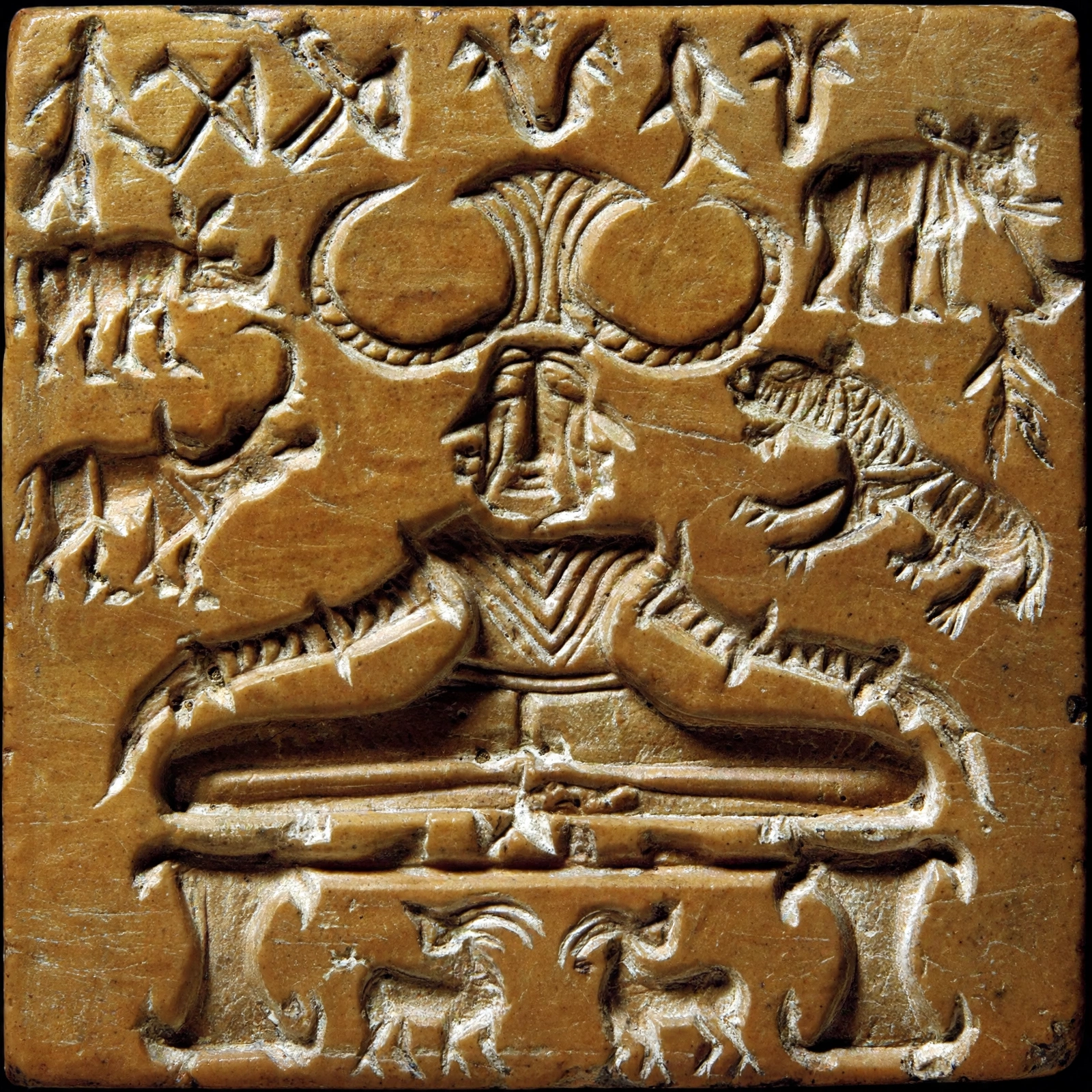
This artefact dates to the Mature Harappan Phase of the Indus Valley Civilisation, approximately 2500–2400 BCE [c. 4,300 years ago]. It was excavated at Mohenjo-daro in the Sindh province of present-day Pakistan and is catalogued as Seal No. 420, also known as the Proto-Shiva Seal. The seal measures 3.56 cm in height, 3.53 cm in length and 0.76 cm in thickness, and is now housed in the Pre-History and Archaeology collection of the National Museum, New Delhi.
Material and Technique: The seal is carved from steatite, commonly known as soapstone. Soapstone is a talc-schist metamorphic rock formed through dynamothermal metamorphism and metasomatism in subduction zones, where heat, pressure and fluid influx alter the rock without melting. Composed predominantly of magnesium-rich talc, which defines value 1 on the Mohs hardness scale, its talc content varies from around 30% in architectural grades to up to 80% in carving grades. This softness makes it easily workable while remaining durable, heat-resistant and capable of high heat retention, qualities that have made it a preferred medium for carving, cooking and heating equipment for millennia.
Iconography: The significance of the seal lies in its complex and unique iconography. At its centre, a horned figure is seated on a raised dais in a meditative posture resembling mulabandhasana or padmasana, with legs bent, heels joined and arms resting lightly on the knees. The arms are adorned with multiple bangles, the chest with striated necklaces or triangular pectorals, and the waist with a double-banded sash terminating in tassels. The lower body appears unclothed. The headdress is particularly elaborate, consisting of two long, curved, striated horns curving inwards towards a central fan-shaped element. The face is characterized by narrow, high-set, downward-slanting eyes, an elongated nose and a downturned mouth, with lateral projections on either side of the head that have been variously interpreted.
The central figure is encircled by fauna. Four large wild animals are arranged around the dais: an elephant and a tiger on one side, and a water buffalo and an Indian rhinoceros on the other. Directly beneath the dais, two deer or ibexes are depicted facing each other, their curved horns almost meeting at the centre. Along the upper edge of the seal is an inscription of seven symbols in the as-yet undeciphered Indus script.
Interpretation and Significance: The identity of the figure has been the subject of sustained scholarly debate. The earliest and most influential interpretation was proposed by Sir John Marshall, Director-General of the Archaeological Survey of India, who first documented the seal. He identified the figure as a proto-form of the Hindu deity Shiva as Pashupati, meaning "Lord of Animals" in Sanskrit. His argument rested on four features: the three faces, the horned headdress recalling the trishula, the yogic posture associated with Shiva as Mahayogi, and the surrounding assembly of animals. He further noted possible ithyphallic and tricephalic characteristics, linking the figure to Rudra.
Subsequent scholarship has challenged this reading. The lateral projections have been reinterpreted as bovine ears rather than faces, leading to alternative identifications as a bovine deity such as Mahishasura or a divine buffalo-man paralleled in other Indus masks and terracottas. Other analyses have associated the iconography, ornaments and scenography with Vedic deities including Agni, Anila and Varuna, or with the sage Rishyasringa. As the Indus script remains undeciphered, the precise identity of the figure remains contested, although there is broad consensus regarding its divine or ritually significant status.
References:
Ref 1: Pashupati Seal - Material, Dating and Iconographic Description - https://imp-art.org/articles/pashupati-seal/ [Your provided source]
Ref 2: Pashupati Seal - Discovery, Dimensions and Present Location - Wikipedia - https://en.wikipedia.org/wiki/Pashupati_seal
Ref 3: Seal No. 420, DK-G Area, Mohenjo-daro Excavation Report (Mackay 1937-38)
Ref 4: Soapstone - Geological Definition and Properties - Wikipedia - https://en.wikipedia.org/wiki/Soapstone
The Mother Goddess Figurines
Period 1 Representation: The Mother Goddess figurines are handmade terracotta images renowned for their intricate fan-like headgear, multi-layered necklaces and distinctive pinched facial features. They are the most numerous and varied class of anthropomorphic artefacts from the Indus Valley Civilisation and are widely excavated across key sites such as Mohenjo-daro and Harappa.
Below is an AI-generated reconstruction of a complete Mother Goddess Figurine; the extant originals are often fragmentary having been recovered from domestic contexts:
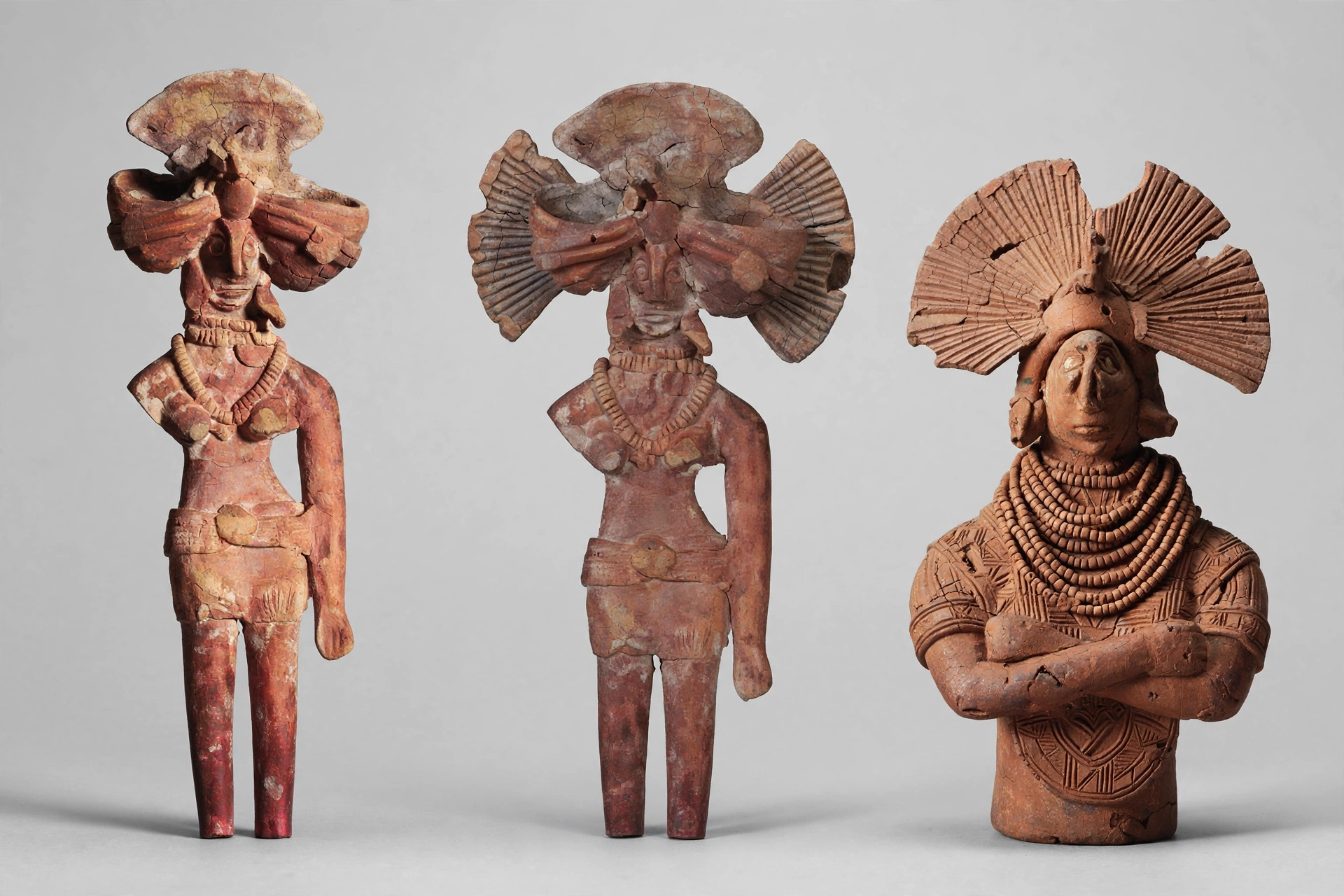
These figurines date to the Mature Harappan Phase, c. 2700–2100 BCE, and are characteristic of the core urban centres of the Indus alluvial plain. Of the approximately 1,000 identified Indus sites, significant numbers of these classic 'headdress' figurines have been found almost exclusively at Mohenjo-daro and Harappa, with related examples at Chanhudaro. Finds become rare or stylistically distinct in peripheral regions such as Lothal, Banawali and Gujarat. They are believed to have developed from earlier Neolithic unbaked clay figures from Mehrgarh in Baluchistan.
Material and Technique: The figures are composed of fire-baked earthen clay coated with a thick red slip, applied not only for lustre but also for surface protection. They are entirely handmade, with appliqué details added separately. Eyes are rendered with small round pellets of clay, the nose is pinched, and black pigment from charcoal is often used to highlight the headdress. Unlike the famous bronze Dancing Girl, which is cast by the lost-wax process, these are low-fired terracotta domestic objects.
Iconography: The defining feature is the elaborate headdress, described as a fan-shaped pannier or cup-like structure suspended on either side of the head, sometimes adorned with cone-shaped forehead ornaments. The figure is typically unclothed above the waist, with bare conical breasts, while the lower garment is secured by three bands fastened with a medallion-like clasp. Adornment is prominent: the figure wears two to three necklaces, the middle one smaller and often bearing four cylindrical pendants, with the longest necklace hanging between the breasts. Large pannier cups at the sides of the head and heavy girdles emphasise status and ornamentation.
Interpretation and Significance: Early excavators, notably Sir John Marshall, misleadingly classified these as 'Mother Goddess' fertility deities, assuming they were kept in wall-niche shrines. Recent analysis has extensively challenged this model. Current research notes that these 'headdress' figurines have been found exclusively broken in secondary contexts such as waste middens, domestic rubbish pits and house floors, with none found in burial or temple contexts, as no temples have been identified in Indus cities. This pattern of deliberate fragmentation and discard suggests an ephemeral, household use, possibly as toys, teaching aids or objects used in inclusive domestic rituals before being discarded at the end of their social life, rather than as a single dominant deity of a cultic system.
References:
Ref 1: Standing Mother Goddess - Terracotta, Handmade, Red Slip, Fan-shaped Headdress, Pinched Nose - Google Arts & Culture - https://artsandculture.google.com/asset/standing-mother-goddess-unknown/FwGDx9VvVAKCyw
Ref 2: Mother Goddess Figurine D.K. 3506/260 - 23 x 8.5 cm, C. 2700-2100 BCE - National Museum New Delhi - https://www.nationalmuseumindia.gov.in/en/collections/index/6
Ref 3: Harappan Headdress Figurines Distribution and Rarity in Core Sites Mohenjo-daro & Harappa - Quest Journals - https://www.questjournals.org/jrhss/papers/vol12-issue4/1204162165.pdf
Ref 4: Terracotta Figurines as Most Important Indus Figures vs Bronze Dancing Girl - PMF IAS - https://www.pmfias.com/the-famous-female-figurine-known-as-dancing-girl/